DBF and SQL represent two different attitudes toward data.
DBF corresponds to a fixed SSD mounted to the case.
The file is visibly present in the file system. You know where it is, when it is opened, who locks it, and when it is released again. Proximity here is not a convenience feature, but part of the mental model. Control is direct, not mediated.
SQL corresponds to outsourcing into a service.
The data disappears behind a layer of abstraction: server, engine, transactions, optimizer. You send a request and receive an answer—what happens in between remains invisible. This is powerful, but it creates distance.
The difference is subtle, but decisive. Outsourcing creates distance. Responsibility is shifted into a realm where ownership becomes abstract and control turns into assumption. Proximity, by contrast, is concrete. What remains visible and physically present resists alienation.
Ownership here is not a legal category, but an attitude. Data that you can see and that has a fixed place remains part of your own workspace—and thus part of your own responsibility. It is not “somewhere else,” it is here, just newly arranged.
Fixing something to the case is therefore more than a practical gesture. It is a quiet commitment to control. The data is not removed from the system, but deliberately anchored within it. Order does not arise from removal, but from structure.
In a digital world that often equates storage with invisibility, this act feels almost archaic. And that is precisely where its strength lies: proximity creates trust, reliability, and clarity.
DBF vs. SQL – a question of proximity, not just technology
The difference between DBF and SQL is not only technical, but above all an attitude toward data.
DBF stands for proximity.
The file is visible, tangible, part of the file system. You open it deliberately, lock it explicitly, write to it, and close it again. Responsibility is direct and traceable. You know where the data is and when you are working with it.
SQL stands for abstraction.
The data resides behind an engine, behind transactions, optimizers, and server processes. You formulate intentions and trust that the system executes them correctly. Control is mediated, not exercised.
Both are legitimate.
SQL scales extremely well; DBF offers immediate transparency.
That is why many developers perceive DBF not as “outdated,” but as close.
Not out of nostalgia, but because cause and effect directly coincide. Errors are visible, states are comprehensible, processes can be mentally modeled.
Similar to locally fixed data:
You do not part with it, you simply arrange it differently.
Perhaps DBF is less a database question than an architectural and trust question.
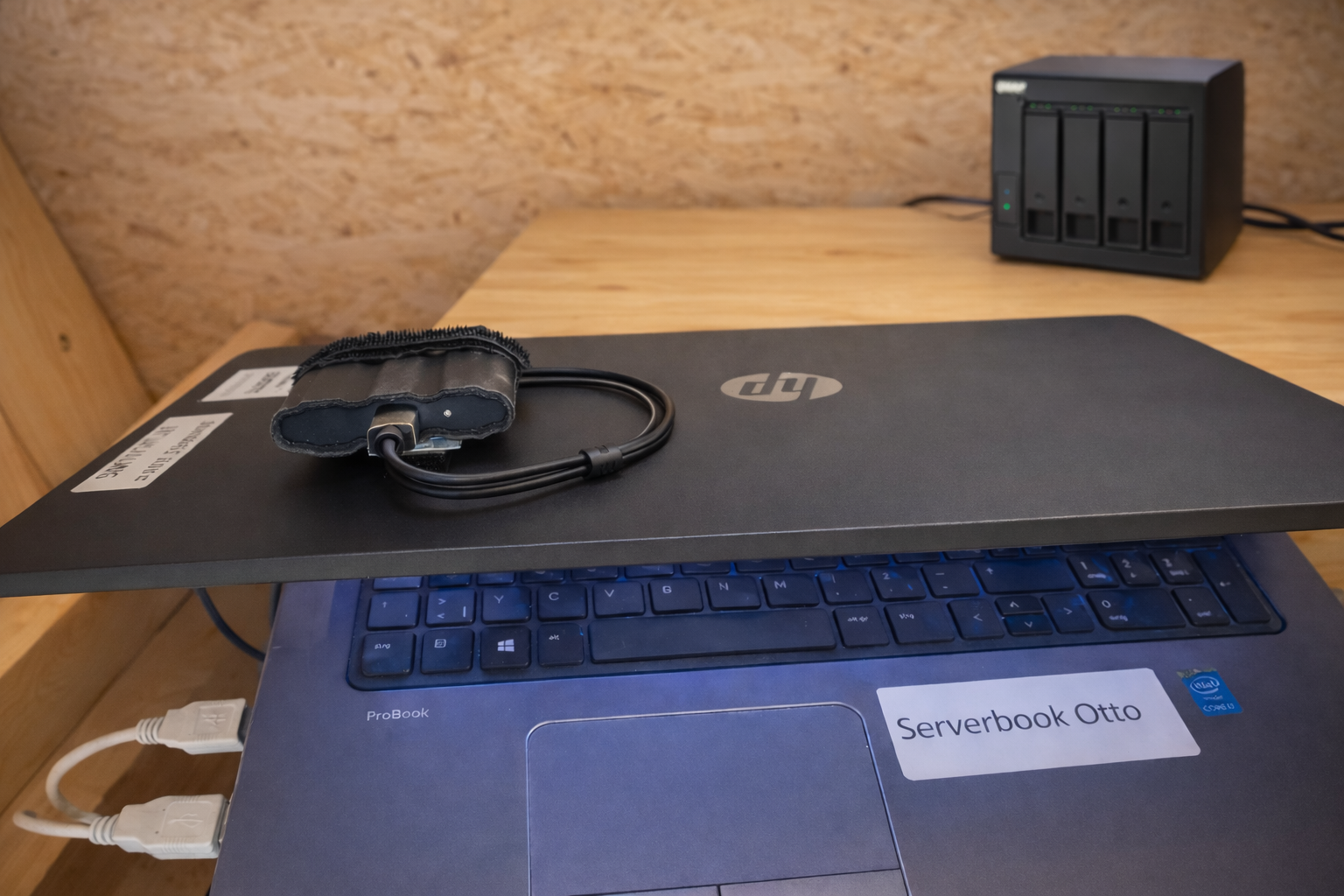
The images show not loose peripherals, but deliberate fixation.
The industrial Velcro turns the external SSD from an accessory into a component of the system. It does not dangle from a cable, it does not lie somewhere beside it—it is anchored. This very act of anchoring transforms “external” into “belonging.”
The direction of the decision is also striking:
Technology does not dominate the workspace; the workspace incorporates the technology. The SSD integrates itself, it gets a place, an orientation, a relationship to the computer. This is the opposite of outsourcing.
The second image reinforces the motif of proximity:
Laptop, cable, SSD—everything remains within a manageable radius. Nothing disappears behind furniture or into drawers. The flow of data is visible, traceable, almost physically perceptible. The system feels calm and self-contained.
Thus a quiet architectural statement emerges:
Data does not need a place where it disappears, but a place where it is allowed to remain.
Fixed here does not mean immobile, but accountable.
As with DBF versus SQL:
The data is not hidden behind a layer, but part of the visible structure. You know where it is—and precisely because of that, you also know what you are responsible for.
The photos therefore do not show a makeshift solution, but an attitude:
Order through proximity.
Control through visibility.
Ownership through relationship.
Both have their justification.
But they feel fundamentally different.
DBF is like working at a workbench:
You reach for it, lock it, modify it, put it back. Responsibility is immediate. Errors are visible, but also understandable.
SQL is like working through a control room:
You formulate intentions, delegate execution, and trust that the system behaves correctly. Control becomes configuration.
That is why many DBF developers feel closer to their data—even if SQL is objectively more powerful. It is not about nostalgia, but about relationship.
Just like with the fixed SSD:
You do not part with the data.
You simply decide how close you want to remain to it.