Dear Antonio,
thank you for your insights.
The more I work with these systems, the more I realize that my perspective may be different from that of a full-time framework or AI developer.
I am primarily an application developer. At the same time, I am involved in marketing, documentation, administration, customer support, web development and product management.
Because of that, my daily challenges are often not purely technical.
I need help with:
- software development
- web design
- SEO
- documentation
- support
- project organization
- business processes
- knowledge management
This is one reason why I am currently focusing more on the orchestration layer than on the execution layer.
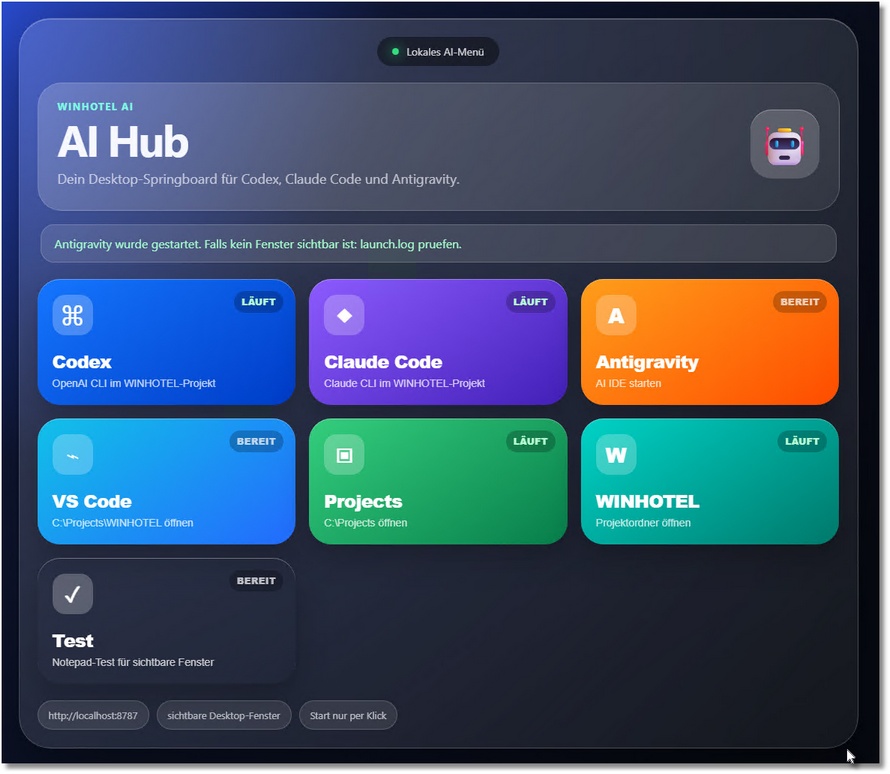
Modern systems such as Codex, Claude Code and Gemini CLI already provide impressive execution capabilities. They can read and modify files, analyze repositories, execute commands, generate plans and automate many technical tasks.
My question therefore becomes:
Where should I invest my own development effort?
At the moment, I believe the greater value for a small company lies in organizing knowledge, workflows, project context, skills and working methods.
This is the direction in which the PE_EDITOR is evolving.
The goal is not to replace Codex, Claude Code or Gemini.
The goal is to make them easier and more useful to apply in everyday work.
Another important aspect is cost.
Whenever possible, I prefer solutions that work within existing subscriptions rather than requiring API usage for every interaction. Fixed monthly costs are easy to understand and easy to accept.
In contrast, variable per-request costs often create hesitation:
"Is this task worth spending credits on?"
That question alone reduces adoption inside a company.
The PE_EDITOR is therefore designed as a practical daily workbench.
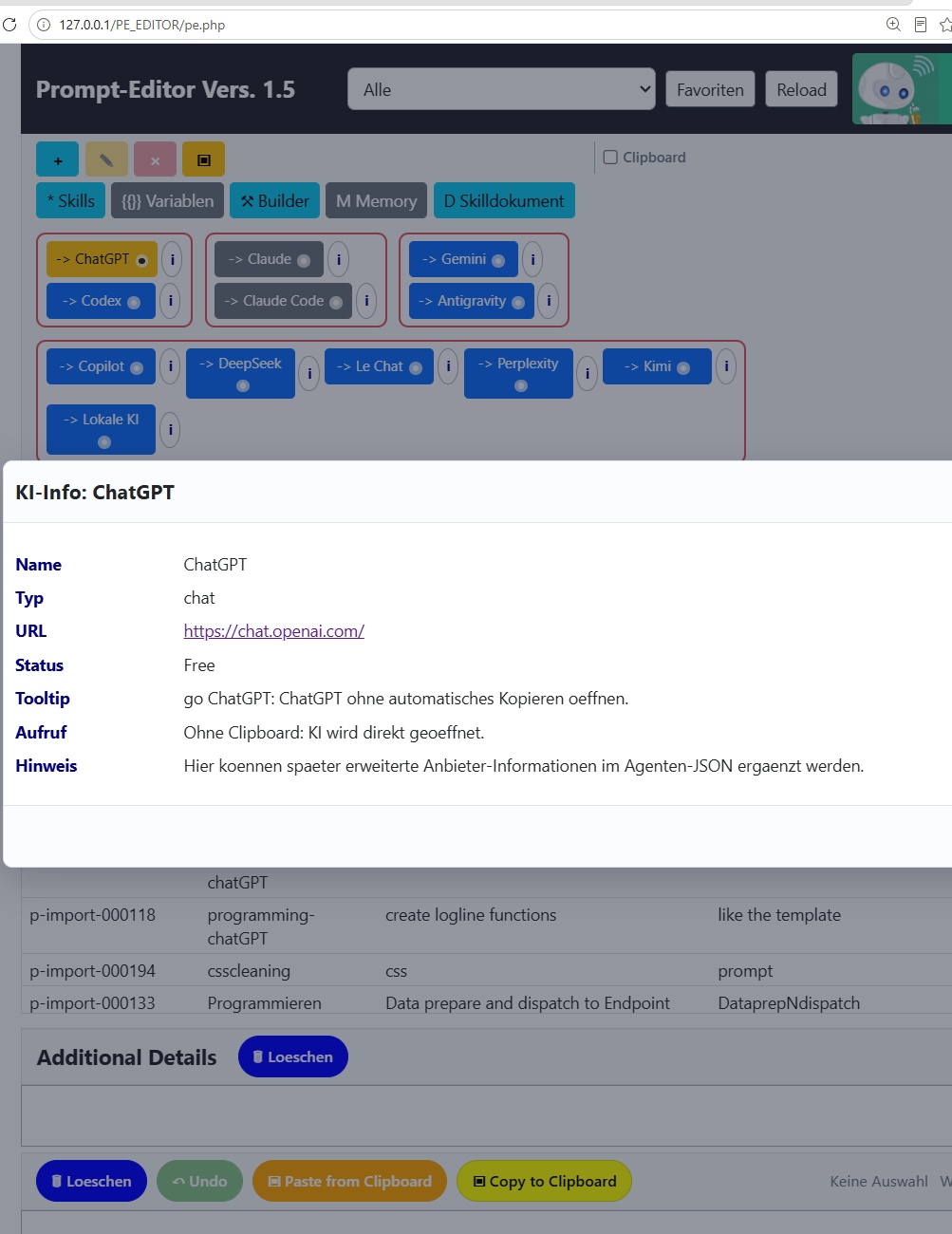
It combines prompts, skills, project profiles, memory, knowledge bases and different AI providers in one place. It also acts as a learning system. When a new AI provider becomes relevant, it can simply be added and documented.
The new interface groups related AI systems together and provides information panels for each provider. The idea is not only to launch an AI, but also to help users understand its strengths, weaknesses, costs and typical use cases.
Perhaps my approach is less about building better agents and more about helping people work effectively with the growing number of agents that already exist.
I may be completely wrong, and this is exactly why I am trying to keep the discussion open.
I would be very interested in hearing where you believe this approach is weak and where a dedicated agent framework provides advantages that I may be overlooking.
Best regards,
Otto